Hello everyone,
I’m a second year undergraduate student with a strong interest in embedded systems and low level software. Over the past year, I’ve been working extensively with STM32 microcontrollers, primarily as part of my university rover team.
Recently, I’ve been using STM32F4 class MCUs for our rover’s traversal and control stack. This involved overhauling large parts of the system, including PID based motor control, ramping/slew-rate limiting, CAN bus communication and multitasking across control and communication subsystems. Working close to the hardware such as timers, DMA, interrupts, and peripherals has helped me build a solid foundation in low level embedded development and I’ve really enjoyed working on it.
Owing to this background I’m particularly interested in the project “Improving the STM32F4 with GPIO, SPI, DMA.” I’ve worked extensively with SPI buses (including multiple slaves and more complex bus topologies) and have used DMA to offload data movement and improve real time behavior. This feels like a good area where I can learn more and also meaningfully contribute by improving the BSP.
So far my contributions to RTEMS include a few documentation fixes, and more recently MR #901: “stm32f4: add stm32f446ze variant and variant-specific linker selection.” which allows user to select linker scripts using option defaults (STM32F4_LINKCMDS) and makes it easier to add new variants going forward. This was inspired by the H7 BSP.
I’m looking forward to learning more about RTEMS, BSP development, and real time systems in general while contributing more meaningfully over time.
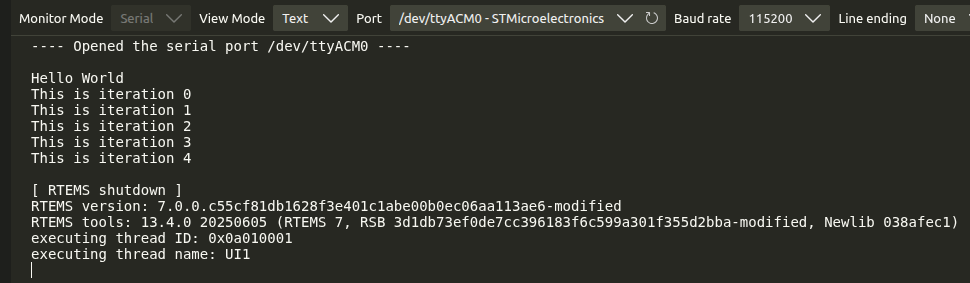
Here is the proof of me getting RTEMS to run on my Nucleo-F446ZE